Best Overall

Made By Johnny WB1484 pleated drawstring palazzo pants
Optional contemporary example with named pleats and drawstring, useful for comparing today’s vocabulary.
Not a historical reproduction or archival garment.
View on AmazonBasics
A photograph of broad trousers is not enough to identify the beginning of palazzo pants. Similar outlines can appear in different periods, under different names, and for different purposes. The history becomes more interesting when those differences stay visible.
Museum records offer a reliable way into the subject. They connect a surviving garment to a maker, a date and an object name. Together, records of earlier evening pyjamas, Irene Galitzine's palazzo ensembles and Emilio Pucci's printed designs show a developing fashion language rather than one person inventing every wide trouser.
As an Amazon Associate I earn from qualifying purchases. Purchases take place on Amazon.
Best Overall
Optional contemporary example with named pleats and drawstring, useful for comparing today’s vocabulary.
Not a historical reproduction or archival garment.
View on AmazonBest Budget
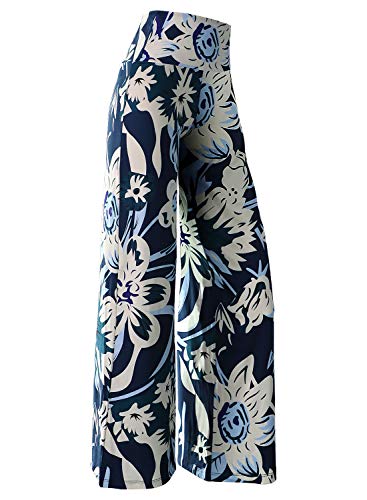
Lower price-tier casual palazzo example showing the modern use of the term.
No documented relationship to a historical designer.
View on AmazonBest Premium

Higher price-tier stretchy palazzo alternative for a contemporary interpretation.
No provenance, period construction or superior quality is implied.
View on AmazonThese are editorial shopping starting points based on listed details, not hands-on tests. Budget and Premium describe relative asking-price tiers among the featured options when researched; they do not establish product quality. Confirm the selected size, composition and current price on Amazon. How we choose examples.
One history concerns shape: trousers with enough width to produce a skirt-like sweep or a relaxed line. Another concerns terminology: the phrase palazzo pyjama and, eventually, the shorter shopping label palazzo pants. These histories overlap without being identical. A wide trouser made before the phrase became familiar is an antecedent, not necessarily a garment that its maker called palazzo.
This distinction avoids two common errors. The first is attaching a modern label to every older photograph that looks similar. The second is assuming that whoever helped establish a memorable name must also have invented the underlying idea of wide trousers. Fashion changes through garments, images, styling, manufacture and language. A careful account can recognize a designer's contribution without erasing what came before or elsewhere.
The Metropolitan Museum's Poiret exhibition material discusses the movement of his theatrical and fancy-dress ideas into fashionable silhouettes. It describes a relationship between costume, publicity and clothing sold to a fashion audience. This is useful early twentieth-century context for understanding how unconventional trouser ensembles could circulate.
It would be a mistake to turn that context into the statement that Poiret invented palazzo pants. His work involved particular silhouettes and an Orientalist fashion vocabulary, and the broader histories of trousers extend beyond Paris couture. Similarity at the level of two loose legs does not establish a direct line of descent. When an archive uses a specific garment name, preserve that name and explain the resemblance separately.
For a reader comparing an old photograph with contemporary pants, the practical question is therefore narrower: what looks similar, and what is different? Examine the ankle, the crotch, the upper-leg shape and the accompanying top. A gathered ankle or a theatrical overskirt can create an outline that is quite different from an open, flowing modern hem.
The V&A's account of Gabrielle Chanel describes 1930s evening pyjamas made from wide trousers and a loose long jacket or tunic. It also records Chanel wearing white satin trousers in New York in 1931 and offering trousers within beach and sportswear ensembles. This establishes that wide trousers could belong to carefully composed fashionable outfits well before the 1960s.
The word pyjamas in that context needs explanation. An evening ensemble intended for entertaining is not simply a pair of modern sleep bottoms worn outside. The setting, accompanying pieces and finish are part of its identity. Looking only at the trousers removes information that helps explain what the outfit meant.
That observation changes how to interpret vintage inspiration today. A coordinated top and pants can echo the idea of a complete ensemble even when neither piece copies an archival garment. The resemblance may be compositional rather than exact: repeated fabric, a continuous color, an elongated top and expansive legs. Call such a combination inspired by evening pyjamas, rather than claiming it is a historical reproduction.
The National Gallery of Victoria catalogs an Irene Galitzine palazzo pyjama dated approximately 1962. The record identifies silk shantung and decorative components. A separate museum-partner record on Google Arts & Culture identifies a formal Galitzine palazzo pyjama from 1960–1961. These are concrete objects associated with the name, maker and period.
The dates matter, including the qualifications. Approximately 1962 is not the same as a documented launch on a particular day. A range such as 1960–1961 is a catalog attribution, not a license to choose whichever year makes a cleaner story. It is enough to say that museum records place Galitzine palazzo pyjamas in the early 1960s.
They also remind us that palazzo pyjama originally names an outfit in these records. Contemporary shoppers often use palazzo for the bottom half alone. When comparing the two, distinguish the complete ensemble from the modern category. The shared word is informative, but it does not mean today's casual elastic-waist trousers have the same pattern, textile or decorative work.
Treccani's dictionary entry for palazzo concerns an important or substantial building, including a palace. The architectural meaning helps explain the grandeur the fashion word can suggest. It does not, by itself, establish who first applied the word to a garment or which particular building inspired that use.
Stories attributing the name to a specific editor, presentation or palace circulate widely. To make one of those stories a firm historical claim, a dated contemporary publication, designer archive or a museum's documented account is preferable to repeated unattributed summaries. The sources used here establish garments and dates more securely than they establish the first published coinage.
There is no need to fill that gap with an attractive guess. A useful short explanation is that the fashion term is associated with elegant palazzo-pyjama ensembles and contains an Italian architectural word. The identity of the first person to use the phrase is a separate research question. Name history and garment history should not be compressed into one unsupported sentence.
The Uffizi holds an Emilio Pucci Pigiama Palazzo dated 1973. Its record describes a long-sleeved top and wide trousers in printed silk, with the named Zadig design in pink tones on white. The surviving ensemble provides a later, specific example of the terminology and format.
It supports saying that palazzo-pyjama dressing continued into the 1970s. It cannot alone establish how many people wore the style, whether it was the decade's dominant trouser shape, or which population adopted it first. A museum object is strong evidence that something existed; mass popularity requires a different body of evidence, such as contemporary sales records or a broad study of period publications.
For modern visual reference, the ensemble suggests looking beyond leg width to the relationship between pieces. Ask how a pattern repeats across the outfit and whether the top reinforces or interrupts the long line. Those are observations you can make from an ensemble without converting them into claims about the habits of an entire decade.
| Period | Documented reference | Reasonable conclusion |
|---|---|---|
| Early twentieth century | The Met's account of Poiret's theatrical and fashion silhouettes | Trouser-related fashion experimentation predates the later palazzo label |
| 1930s | V&A description of Chanel evening pyjamas | Wide trousers were used in coordinated elegant ensembles |
| 1960–1961 | Museum-partner Galitzine formal-pyjama record | The palazzo-pyjama name is attached to a surviving early-1960s design |
| About 1962 | NGV Galitzine collection object | Another dated institutional example supports the association |
| 1973 | Uffizi Pucci ensemble | The named ensemble continued into the following decade |
| Present-day shopping | Retailers use palazzo across varied trouser listings | The term now has broader commercial applications |
Today's catalog names show the range. Arolina's high-waist flowy palazzo pants are presented with casual and summer language. Made By Johnny WB1484 is explicitly described with pleats and a drawstring. Neither title claims to reproduce Galitzine's museum pieces, and neither should be introduced as though it did.
A more dressed-up listing such as Rekucci Travel in Style stretchy palazzo wide-leg pants offers another contemporary interpretation. These examples show how the name functions now: it can identify a shape and an intended use within a marketplace. Their role in this article is comparison with current vocabulary, not historical authentication or a ranking of reproductions.
If you want to understand the present-day shape before choosing a pair, use our definition guide. If your interest is an archive-inspired outfit, choose the element that appeals to you—coordinated pieces, broad movement or printed fabric—and describe that inspiration precisely.
Begin with the caption. Record the maker, date range, object title and institution before drawing conclusions from the picture. Then distinguish what the image visibly shows from what only the accompanying text establishes. A photograph can show a broad hem; it cannot reliably establish fiber percentages, original wearer's comfort or whether a garment was widely sold.
Next, check whether the outfit is complete. A missing jacket or an altered hem can change its proportions. Museum styling, conservation supports and the way an object is photographed can also affect how it appears. These are reasons to read carefully, not reasons to dismiss the evidence.
Finally, use historical reference as a source of ideas without making provenance claims for modern purchases. A contemporary printed pair can evoke a period mood while remaining a contemporary garment. That vocabulary lets you enjoy the history and the clothes without confusing influence, resemblance and an authenticated original.
The evidence supports important designers and dated ensembles rather than one inventor of every wide-leg trouser. Galitzine is firmly associated with early-1960s palazzo pyjamas in museum collections, while the V&A documents earlier Chanel evening pyjamas. Credit the particular contribution instead of assigning the entire silhouette to one person.
No. Galitzine museum records date to the early 1960s, and earlier wide-trouser ensembles provide context before that. The Uffizi’s 1973 Pucci example confirms a later continuation. Those dates establish specific objects, not a statistical account of when the style reached its largest audience.
The Italian word has an architectural meaning, but a dictionary definition does not establish a garment’s invention story. Claims about a particular palace or the first person to name the outfit need separate historical documentation. The association with elegant ensembles is clearer than the exact first coinage in the sources used here.
Usually they are contemporary garments sold under a broad style name. A resemblance in width or coordinated styling does not establish a copied pattern or historical construction. A seller should provide specific provenance or design information before a garment is described as an authenticated reproduction.
The strongest history follows documented garments: earlier wide-trouser ensembles, Galitzine palazzo pyjamas in the early 1960s, and Pucci’s printed 1973 example. Keep the complete outfits, their dates and their original names visible. They explain the style more reliably than a tidy story that one person invented every flowing trouser. The modern term has broadened, which is why casual pants and dressier separates can share it. When borrowing a historical idea, identify the detail you are borrowing and let the new garment remain its own design. That approach preserves both the pleasure of the reference and the accuracy of the history.