Best Overall

Arolina Stretchy lounge palazzo pants with pockets
Optional flowing lounge-palazzo example when considering a relaxed finish.
Rayon content and steam permission are not established by its listing title.
View on AmazonCare
One leg of a palazzo pant can be wider than an ironing board. Flattening the whole garment at once is therefore a poor starting point: while you chase a crease on the front, the back can collect a new one underneath. Treat each panel as a separate finishing task.
Whether to use an iron, a steamer or neither comes first. Rayon on the fiber label does not settle that choice, and a steamer is not automatically a safe substitute for a prohibited iron. Read the garment's finishing instructions, prepare a supported working area and test the method before moving onto the visible front.
As an Amazon Associate I earn from qualifying purchases. Purchases take place on Amazon.
Best Overall
Optional flowing lounge-palazzo example when considering a relaxed finish.
Rayon content and steam permission are not established by its listing title.
View on AmazonBest Budget
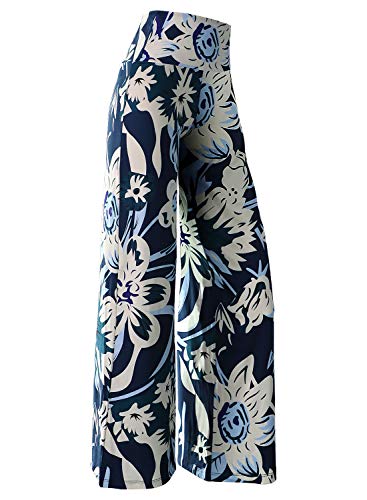
Lower observed price-tier wide-leg silhouette to compare for everyday dressing.
Do not apply a rayon iron setting without the actual care label.
View on AmazonBest Premium

Higher-priced chiffon palazzo dress-pant example for a more formal presentation.
Chiffon describes the listing fabric style; heat tolerance and fiber content remain unverified.
View on AmazonThese are editorial shopping starting points based on listed details, not hands-on tests. Budget and Premium describe relative asking-price tiers among the featured options when researched; they do not establish product quality. Confirm the selected size, composition and current price on Amazon. How we choose examples.
Read the care label in good light, turning it over if necessary. Look for a finishing instruction rather than treating the wash temperature as an iron setting. If symbols are unfamiliar, consult a current care-symbol reference and the manufacturer for ambiguity. A label may permit ironing with a restriction that matters to the particular blend or finish.
GINETEX's textile-care reference says ironing temperature should follow the garment label rather than the fiber name; it also identifies a low-temperature, no-steam treatment. That distinction is the reason this guide does not supply one universal rayon setting. Appliance dials may group fibers together, but your pants can include more than the named outer fabric.
If the label prohibits ironing or steam, pause. Do not reinterpret hovering, pressing through a towel or briefly touching the surface as a different permission. Ask the maker what finishing, if any, is appropriate. Some texture is intentional, and an unclear instruction is not an invitation to experiment on the most visible part of a garment.
| Your goal | Potential method if permitted | What to watch |
|---|---|---|
| Relax a soft packing crease | Controlled steaming | Moisture, spotting and unsupported fabric |
| Smooth a broad panel precisely | Supported ironing or pressing | Hidden folds and excess pressure |
| Preserve an existing pressed crease | Careful alignment and permitted pressing | Accidentally creating a second crease |
| Protect a permanent pleated finish | Follow its specific instructions | Assuming all pleats tolerate steam |
Choose the smallest intervention that serves the outfit. A relaxed palazzo worn casually need not have the finish of a sharply tailored trouser. If you only want a packing line softened, there is little reason to press an entirely new crease down the leg. If a formal crease is part of the design, freehand steaming alone may not give the definition you want.
For pants with small repeated pleats, move to the pleated-pants care guide. Their finishing requirements can differ substantially from an unpleated rayon panel, even when the overall silhouette looks similar.
Use a stable ironing board or another surface explicitly suitable for the appliance. Clear objects that could imprint through the fabric, and check the cover for marks or rough areas. Keep the broad leg supported on the board and nearby clean space rather than letting it drag across the floor. Good support lets you move the panel calmly without stretching it.
Inspect the iron's soleplate or steamer head according to the manual. Old residue, mineral deposits or a damaged surface deserve attention before the appliance touches a pale garment. Use the water the appliance manufacturer specifies; do not improvise with perfume, starch or additives in a reservoir designed for water alone. Check the controls each time rather than relying on the setting left from a previous linen shirt.
Keep steam and hot surfaces away from your skin. Never finish pants while wearing them, and do not use your hand behind the fabric as a convenient pressing surface. Arrange the cord so it will not tug the appliance as you turn a large panel. Practical preparation makes a careful test easier to repeat across both legs.
Choose an inconspicuous area representative of the visible fabric, such as a concealed section inside the hem where construction allows. A thick waistband facing may not represent a thin leg panel. If there are contrasting colors or decorative finishes, one hidden test may not answer every question; use additional appropriate areas or ask for professional assessment.
Test the permitted method with the planned cloth, orientation and setting. Then wait for that area to cool and dry before judging it. Look from more than one angle for a change in sheen, color, texture or shape. A damp area can temporarily look darker, while a pressure mark may become obvious only when the light hits it sideways.
If the result is uncertain, stop at the test area. Raising the heat because nothing happened quickly defeats the point of a controlled check. Make only a permitted adjustment you understand, and assess again. The aim is to establish a workable method, not to see how much treatment the garment will tolerate.
Turn the pants to the orientation their instructions recommend, often using the reverse where appropriate. Lay one leg on the board with the fabric smooth underneath as well as on top. Feel for pocket bags, seam allowances and doubled fabric before applying pressure. It is easy to press a pocket edge into a light front panel when the pocket is folded unnoticed below it.
Finish a manageable area, then lift and reposition the garment instead of dragging a large expanse sideways. Keep checking that the layer beneath has not formed a ridge. If you use a press cloth, choose a clean one suited to the task and the instructions; it is a protective aid, not permission to exceed the label's limits.
Move from less visible areas toward the main panels once the test has proved satisfactory. Around a waistband, work only on sections you can support properly and respect elastic or trim restrictions. If the band is gathered, do not flatten the gathers into a new shape simply to make the ironing easier. Their arrangement is part of how the pants fit.
Where steaming is permitted, hang or support the pants in the way required by their construction and the steamer instructions. Keep the garment stable so you can treat a small section without pulling the hem taut. Follow the device's specified working distance and use pattern rather than adopting an arbitrary distance from a video for another model.
Asia Pacific Rayon's general viscose guidance mentions steaming as a finishing option after drying. It does not override a finished garment's restrictions. Check for lining, print and pleated details before treating that guidance as relevant to your particular pair.
Pay attention to water droplets or spitting. If the appliance leaves visible wet spots, stop and consult its manual rather than repeatedly steaming over them. Let the area dry to assess the result. Do not pull the opposite leg down to straighten a stubborn crease; that changes the task from finishing into uncontrolled reshaping.
A seam ridge, an intended crinkle texture and a wrinkle from storage are not identical. Compare the affected area with another part of the pants and with an earlier photograph if you have one. If a repeated texture extends evenly across the fabric, ask whether it belongs to the design before trying to erase it.
Shine or a changed surface after heat is not simply another crease requiring more pressure. Stop and preserve the evidence. Likewise, a leg that remains shorter after finishing belongs in a dimensional-change assessment, not a hotter ironing session. Use the shrink-recovery decision guide to separate a fit problem from a finishing problem.
For an event, choose a presentable result you can safely achieve with the time available. Trying to perfect a last faint line immediately before leaving is a common way to abandon the careful method that worked elsewhere. A replacement outfit can be a better decision than escalating treatment on a sentimental pair.
Let the pants cool and become fully dry, then arrange them as you will wear them. Check that one leg has not acquired a crease the other lacks. Look at the waistband, pockets and hem from the front and side. These checks catch inconsistency that is difficult to notice when your attention is fixed on one small area of an ironing board.
Store the finished pair without immediately crushing the treated panel under a stack. For a later event, allow enough space that the pants can be retrieved without pulling against adjacent hangers. A good finishing result is easier to preserve when storage is part of the plan rather than an afterthought.
When browsing future silhouettes, compare the Arolina lounge palazzo with pockets with the Alex Evenings chiffon palazzo dress pant. They illustrate different intended looks, not a common heat setting. The returned titles do not confirm rayon content or finishing permission for either item, so ask for exact composition and care details before expecting one routine to serve both.
It avoids direct soleplate pressure, but still introduces heat and moisture. That does not make it acceptable when the garment prohibits steam or when its finish has special restrictions. Choose by the actual care instruction and the result you need.
Treat the dial as an appliance control, not a garment instruction. First establish the allowed treatment from the pants label, then use the manual to select a compatible setting. Mixed fibers and finishes may require a different limit.
A folded pocket bag or thick edge underneath can influence the surface you press. Stop, let the fabric cool and inspect the layers. Reposition them before another permitted treatment rather than increasing pressure over the outline.
Only if that is the finish you want and the construction supports it. Many flowing styles are intended to hang without a tailored center crease. Preserve an existing design choice instead of automatically adding one.
Finishing rayon palazzo pants works best as a series of small, supported decisions. Establish whether heat and steam are permitted, test the actual method, and handle one panel without trapping another layer beneath it. Keep the desired result in view: soft drape does not require every garment to look sharply pressed. A changed sheen, persistent spot or uncertain pleated finish is a reason to stop and ask for garment-specific guidance. Once both legs look consistent, let the pants settle before storage. Choosing future pairs with clear finishing instructions will make the next ironing-board session much easier to plan.