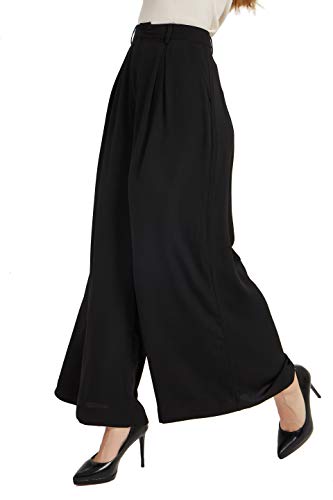
The useful question is not whether wide trousers count as professional clothing. It is whether your particular pair belongs in the room where you will interview. A crisp trouser with controlled movement, a beach cover-up, and a shiny party pant may all appear under the palazzo label, yet they communicate very different levels of formality.
Begin with the employer's instructions and the interview format. Then assess the actual outfit you can put together, including shoes, bag, and outer layer. You should be able to sit, present, walk between rooms, and concentrate on the conversation without managing your clothes.
Shopping starting points
As an Amazon Associate I earn from qualifying purchases. Purchases take place on Amazon.
These are editorial shopping starting points based on listed details, not hands-on tests. Budget and Premium describe relative asking-price tiers among the featured options when researched; they do not establish product quality. Confirm the selected size, composition and current price on Amazon. How we choose examples.
Linked Amazon product image. See the exact listing for garment details.
Read the interview invitation before your wardrobe
Search the scheduling email for clothing instructions, a site visit, a presentation, or a note that the team dresses casually. These details outrank a generic outfit photograph. A panel interview in a headquarters meeting room may involve different practical needs from a studio portfolio review or a tour of an operating facility. For a site visit, ask about required footwear and clothing before choosing wide hems.
The Harvard Mignone Center professional attire guide recommends business formal for interviews unless the employer gives other instructions. That is a useful conservative starting point, not proof that every employer requires a suit. If a recruiter explicitly requests business casual, follow that direction rather than assuming that maximum formality always makes the best impression.
Separate evidence from assumptions
Look at employer recruitment material showing people doing the kind of work you are applying for. Give more weight to an interview information page than a company party photograph. An executive portrait does not establish the everyday dress code of a technical team, and an employee wearing jeans does not necessarily tell you what the employer expects of interview candidates.
A short question can settle uncertainty: ask whether candidates should plan for business formal, business casual, or another specific standard. There is no need to ask the recruiter to approve a shopping link. Gather the level of formality, then make the clothing decision yourself. If you cannot obtain an answer, a quiet, coordinated outfit with a jacket is a practical starting point for many office interviews.
Use this decision table to choose the trouser
What you know
Palazzo approach
What to resolve
Business formal requested
Consider a matching trouser suit with restrained wide legs
Whether separate pieces meet the requested standard
Business casual specified
Opaque palazzo trousers with a simple blouse and jacket
Fabric finish, hem clearance, and overall neatness
Creative portfolio interview
Use a distinctive cut within a controlled outfit
Whether the clothes compete with the work you are presenting
Practical demonstration or site tour
Choose clothing around the activity requirements
Wide hems, required shoes, and any stated restrictions
Video interview
Wear the complete outfit and test it on camera
Neckline, jacket behavior, and visible contrast
This table is a planning aid. It cannot replace an employer's written directions or the requirements of a particular activity.
What makes a pair read as interview trousers?
Look first at how the fabric hangs when you stand still. A clean fall from the hip, a waistband that stays level, and hems without accidental pooling create a composed outline. Very broad legs are not automatically inappropriate, but they become harder to manage if the fabric billows around chair wheels or spills across the floor. You can preserve the wide-leg feeling while choosing less sweep.
Next inspect the surface. For a restrained interview outfit, matte or gently textured fabric is often easier to coordinate than prominent shine, exaggerated crinkling, or a large holiday print. This is a styling preference, not a claim about fiber quality. A polyester trouser can look tailored, and a linen trouser can look formal or relaxed depending on its construction and finish.
The Tronjori high-waist palazzo business pants in black are a relevant starting point because the exact listing identifies a high waist and business-pant styling. The title does not establish fabric composition, opacity, or how the listed XL fits you. Check the selected model rather than borrowing details from another Tronjori result.
Build around one reliable upper layer
Try the trousers with a blouse or fine knit that stays comfortably in place when you sit. A neckline that requires frequent adjustment is a distraction even if it looks attractive in a standing photograph. Decide whether to tuck the top before fitting the jacket; a bulky tuck can change how both the waistband and jacket front sit.
A jacket can give a flowing lower half a clear frame. Start with a shoulder fit that lets you reach forward and a front that hangs without pulling. A cropped jacket emphasizes the waist, while a longer blazer creates a more continuous outline. Neither length is inherently more professional. The useful choice is the one that looks coherent open and closed, if you expect to fasten it.
Avoid assuming that two black garments form a suit. Different undertones and surfaces can be obvious in daylight. If they almost match but look accidental together, use a clearly contrasting jacket, such as a muted gray over black trousers, for an interview where separates are appropriate. For a formal suit requirement, select pieces intended to coordinate.
Make shoes and hems a single decision
Choose the shoe you can walk in confidently, then check the trousers over it. A closed flat, loafer, or low heel can all support a restrained outfit depending on the employer's expectations. A heel is not necessary to make wide trousers look considered. What matters practically is that the hem does not slide under your foot as you enter, turn, or stand from a chair.
Walk across a room at your normal pace and use a staircase if the interview location is likely to have one. A trouser that needs to be held up for every step is poorly suited to carrying a bag and greeting people. See the palazzo length guide for setting hem clearance rather than improvising with unfamiliar shoes on interview morning.
Consider a narrower alternative without losing the idea
If the palazzo pair feels too fluid for the setting, a tailored wide-leg trouser can provide a similar visual direction with a different amount of movement. The PRETTYGARDEN tailored wide-leg work dress pants in coffee are listed as tailored work trousers, making them an adjacent option to compare. They should not be described as a proven flowing palazzo simply because the legs are wide.
For another comparison, the Rekucci Travel in Style stretchy palazzo pants in black offer a title-supported stretch-oriented alternative. That wording does not prove a particular waistband design or guarantee all-day comfort. Try the actual pair with your chosen top and assess the whole outfit, rather than treating a work or travel label as an employer endorsement.
Rehearse the moments an outfit photo misses
Spend time in the outfit at a desk. Set a notebook on a table, reach into your bag, stand, and put your jacket back on. Notice whether the waist digs in, whether the top comes untucked, and whether the legs catch on the chair. This rehearsal is about your particular clothes and movements; it does not require a complicated fit scoring system.
For a video interview, use the camera and room you intend to use. Check the view when you lean forward to listen. Look for a jacket that rides toward your ears, a neckline that shifts, or a very small pattern that looks distracting on screen. Wear the trousers too: you may need to stand, and a complete outfit makes the rehearsal realistic.
Keep the supporting details quiet and functional
Select a bag that holds what you actually need without requiring you to carry several loose objects. Try it over the jacket shoulder, especially if the jacket fabric is slippery. Empty trouser pockets of bulky items that change the front line; keep a phone and keys in a consistent bag compartment so they are easy to find afterward.
Jewelry can be simple without erasing your style. If a bracelet taps on the desk or an earring catches the collar during your rehearsal, change that particular item. There is no universal need to eliminate color or personal accessories. The goal is an outfit that supports conversation instead of repeatedly asking for attention.
Prepare the clothes according to their actual care labels with enough time to resolve a crease or mark. Put the complete combination aside together. If your preferred trousers still need alterations close to the interview, a familiar pair that already fits is often the more dependable choice.
Frequently asked questions
Can I wear palazzo pants without a blazer to an interview?
Possibly, when the employer has specified a level of dress that the remaining outfit meets. A neat blouse and opaque trousers may fit some business-casual settings. For a business-formal request, do not assume that removing the jacket leaves an equivalent outfit. Clarify the standard before simplifying.
Are black palazzo pants automatically interview appropriate?
No. Color does not settle fabric transparency, leg volume, waistband appearance, or suitability for the activity. A black beach cover-up and a black tailored trouser serve different purposes. Evaluate the actual garment with the full outfit and the employer’s instructions.
Should I buy a new pair specifically for the interview?
Only if the clothes you own cannot meet the practical and dress requirements. A familiar trouser with an adjusted hem may serve you better than an untried purchase. If buying, allow time to inspect the selected size, practice sitting, and assemble the jacket and shoes.
What if the interview includes an informal office tour?
Ask whether the tour has clothing or footwear requirements, especially if it includes a workshop, laboratory, or operational area. Choose an outfit that works for the entire visit. A sweeping hem is a reason to reconsider the garment when the itinerary requires frequent stairs or movement around equipment.
Final Verdict
Choose palazzo pants for an interview when the exact pair meets the stated dress standard and passes an ordinary movement rehearsal. Employer instructions, fabric coverage, and hem control matter more than the silhouette’s name. A restrained blouse, coordinated jacket, and familiar shoes make the decision easier, but they cannot turn a casual cover-up into formal tailoring. If a true palazzo feels too dramatic for the setting, a tailored wide-leg alternative is a reasonable adjustment. Finish the outfit early, check it seated and standing, and let your attention move back to preparing examples, questions, and the conversation itself.