Best Overall

Dokotoo High-waist palazzo pants
The listed elastic drawstring construction offers a concrete adjustability feature to assess.
Elastic pressure and front room remain untested.
View on AmazonFit
If the waistband is the first thing you want to loosen when you sit down, the outfit needs a different fit or construction. A flowing leg can feel wonderfully roomy while the upper few inches of the same garment remain restrictive. Shopping by “wide-leg” alone will not resolve that mismatch.
You do not need to disguise your abdomen to wear palazzo pants. Focus on where the waistband rests, how the front accommodates your shape, and whether the fit remains comfortable through normal changes of position. Those are clothing decisions you can observe and compare.
As an Amazon Associate I earn from qualifying purchases. Purchases take place on Amazon.
Best Overall
The listed elastic drawstring construction offers a concrete adjustability feature to assess.
Elastic pressure and front room remain untested.
View on AmazonBest Budget

Lower observed price for an elastic-waist stretchy wide-leg comparison.
The title also says straight leg; no dramatic palazzo or comfort guarantee.
View on AmazonBest Premium
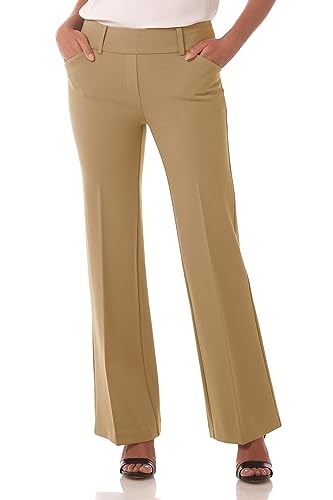
Higher-priced pull-on example naming several length-fit categories.
Shaping language is not evidence of comfort, and this is adjacent office wide-leg styling.
View on AmazonThese are editorial shopping starting points based on listed details, not hands-on tests. Budget and Premium describe relative asking-price tiers among the featured options when researched; they do not establish product quality. Confirm the selected size, composition and current price on Amazon. How we choose examples.
Begin with a specific observation. Is the band tight all the way around, concentrated at the front, folding along its depth, or sliding down? Does the crotch pull when you sit, or does the waistband alone feel restrictive? These are different problems. Writing “front band presses when seated” is more useful than deciding that palazzo pants do not suit you.
Try the trousers without heavy pocket contents and with the underwear you normally wear. Avoid judging a pair immediately after forcing it into a position where it does not naturally stay. If loosening a drawstring improves the band but leaves pulling across the front, there may still be insufficient room in the garment. If the front is comfortable but the back gaps, a different waist shape may help more than a larger size. Use the fit guide for broader crotch and seat diagnosis.
Rise is part of the relationship between the crotch and waistband. A high-rise label does not provide a universal measurement or guarantee that the band will rest above your abdomen. Your torso length and the garment's cut affect the result. Compare the waistband position on your own body rather than borrowing the model's proportions.
Try a higher and a lower position briefly, then notice where the pants settle when you walk. If moving the band solves one problem but makes the crotch hang or pull, you need another cut rather than more determined styling. Closet Core's pants-fitting guide treats room through the abdomen as a pattern-shaping issue that can require both length and width. That is why adding circumference at the waistband does not automatically correct every tight front. The observation is about fabric allocation, not a judgment about your shape.
| Construction | What it offers | What to test |
|---|---|---|
| Fully elastic casing | Flexible opening without a separate fastening | Firmness, recovery, and contact while seated |
| Elastic plus drawstring | Adjustable hold | Whether the knot creates pressure beneath a top |
| Flat front, elastic back | Smoother front with some waist flexibility | Whether the front panel still has enough room |
| Fixed waistband with fastening | A defined tailored edge | Comfort through movement and the chosen sitting position |
A wide band is not automatically gentle, and a narrow band is not automatically uncomfortable. Fabric, elastic strength, construction, and the size chosen all contribute. Smocking is also a separate arrangement: rows of elastic create texture and distributed gathering, but the finished depth may suit one wearer better than another. Try the complete waistband rather than choosing from a single descriptive adjective.
Pleats, gathers, darts, and a smooth front release fabric in different ways. Pleats can provide volume below the waistband, but a particular pair may still pull where they are stitched closed. Gathers introduce fullness immediately at the waist. A smooth front can work very comfortably if the pattern gives it sufficient room. None is guaranteed to conceal or emphasize the same thing on everyone.
Check whether pleats relax when you stand naturally. A little opening can be part of the design; tension accompanied by discomfort is a more useful warning than a strict visual rule. Look from the side as well as the front. If the waistband tilts because the front is being pulled down, note that behavior. Do not compensate by tightening a belt at the back. The waistband alteration guide explains which changes concern circumference and which require a more involved assessment.
Use the kind of chair you sit in most often, with your feet placed normally. Spend a few minutes reading or using a laptop so you stop holding a fitting-room pose. Reach toward a table and stand again. Notice whether you need to adjust the band, pull the front away, or rearrange the crotch before moving comfortably.
Repeat the check with your intended top. A shirt tucked into the waist adds material; a bulky seam or knot may feel different under that layer. You do not need to quantify comfort with an arbitrary finger rule. A waistband can admit a certain number of fingers and still feel unpleasant in use. Record whether the fit stays comfortable without constant attention. If the seller permits only a limited indoor try-on, respect that condition while making the observation.
A fabric may feel soft between your fingers and still be cut too narrowly. Stretch may help movement, but it does not guarantee low pressure or adequate front length. Likewise, a nonstretch woven can be comfortable when its dimensions and shaping allow room. Choose the garment's behavior over the promise implied by one fiber or marketing term.
Look for the front fabric to move when you walk rather than remain pulled taut. Check any lining separately because it may have a different amount of stretch. Avoid assuming that washing will enlarge a tight garment or that a synthetic fabric will never change shape. The care label governs treatment. If a listing calls a waistband “sculpting” or “tummy control,” translate that into questions about firmness, construction, and your preference; it is not proof of comfort and does not establish a health benefit.
For minimal pressure, begin with an untucked top that does not need to be wedged under the band. If you prefer a tuck, try a lighter fabric and leave enough room for movement. A full tuck, partial tuck, and loose hem each organize the outfit differently. Choose the one that lets you forget about the waist once you are dressed.
A longer top may provide the coverage you want, but it should not be necessary to tolerate a poor fit. Check that its hem does not catch on a drawstring knot or bunch over pockets. An open overshirt can create another layer without adding material inside the waistband. These are styling options, not instructions to hide your abdomen. A visible waistband and a fitted top are equally valid if you like them and the clothes feel comfortable.
The DOKOTOO high-rise elastic drawstring lounge palazzo listing explicitly combines an adjustable tie with elastic. It is a relevant example if adjustability is your priority, although the title cannot tell you how firm the elastic feels. The Urban CoCo elastic high-waist stretch wide-leg listing offers a different description to investigate. Its title also includes straight-leg language, so treat it as an adjacent relaxed option rather than assuming a dramatic palazzo sweep.
The Rekucci pull-on stretch wide-leg office pant names regular, petite, and tall fits in its title. Those proportions may be worth comparing when the rise and waist location matter more than leg width. Its product name includes shaping language, which should not replace a comfort assessment. Read the selected size chart and exact material information before deciding which construction addresses your particular observation.
A belt can help keep an otherwise comfortable waistband in place. It is less useful when tightening it creates folds, changes the rise, or concentrates pressure at the front. If the pants fit the hips but gap at the back, a shaped waistband or limited alteration may offer a cleaner solution than cinching a large amount of excess fabric.
Keep belts loose enough for the intended movement and use the garment's belt loops only as designed. Do not attach improvised fastenings that strain a small section of fabric. If the band is tight from the beginning, an extender may change the closure position without supplying needed room below it. Treat temporary devices as limited experiments, not substitutes for an appropriate size. Your best result may be a different model with similar flowing legs and a completely different upper construction.
After trying a pair, record the preferred band position, whether it stays there, and which movement exposes a problem. Add the construction type and the exact size. This creates a useful comparison for the next pair: “elastic comfortable but front too short seated” is far more actionable than “size large did not work.”
Keep ordinary variations in your day in mind. Choose enough adjustability or ease for the situations you expect, without assuming a garment should fit identically in every posture. If you need frequent changes in waist setting, an accessible drawstring may be practical. If a smooth top is central to your wardrobe, a flatter fastening may matter more. The final decision should reflect how you dress and move, rather than an idealized waist shape promoted in a product description.
Choose the position that feels comfortable and stays stable while you move. Neither is universally correct. If changing the band position makes the crotch pull or sag, compare a different rise.
They provide adjustment, but comfort depends on the elastic beneath them, the knot, and the garment fit. A drawstring cannot create missing room through a tight front panel.
It may help when circumference is insufficient, but it can also create excess elsewhere. A different rise or pattern shape may be needed when the front pulls despite a loose waistband.
Choose palazzo pants for the way the upper garment accommodates you, then enjoy the flowing legs. A comfortable waistband remains usable through sitting and movement without requiring constant repositioning. Compare rise, elastic firmness, front shaping, and the practical effect of a drawstring or fastening. Keep the distinction between missing room and unwanted looseness clear: tightening a band cannot solve both. Styling can organize the outfit, but it should not be used to make a restrictive pair tolerable. The most useful purchase is a cut that works with your preferred band position and everyday activities, regardless of whether its marketing promises a particular visual effect.