The nicest photograph on a pattern envelope cannot tell you whether you will enjoy making the pants. A sweeping leg may hide a zipper you have never installed, while a plain-looking pull-on pattern may offer the exact rise and waistband you want. Choosing well means reading the drawing and instructions as carefully as the styling photograph.
Start with the garment you intend to wear: its waist position, fullness, pockets and everyday shoes. Then find a pattern whose construction already supports those choices. Changing every feature of a pattern is a design project of its own, and it can make an apparently simple first pair unexpectedly demanding.
Shopping starting points
As an Amazon Associate I earn from qualifying purchases. Purchases take place on Amazon.
These are editorial shopping starting points based on listed details, not hands-on tests. Budget and Premium describe relative asking-price tiers among the featured options when researched; they do not establish product quality. Confirm the selected size, composition and current price on Amazon. How we choose examples.
Linked Amazon product image. See the exact listing for garment details.
Write a short specification before shopping
Give your project five requirements: waistband style, leg fullness, finished length, pockets and preferred fabric. Separate requirements from preferences. Perhaps a pull-on waist is essential because you dislike a firm band, while side pockets are optional. That distinction makes it easier to reject an attractive pattern that would require substantial alterations.
Use a pair you already own as a reference for features, rather than assuming its size number will transfer. A favorite trouser can show the waist position you enjoy and whether you like fabric gathered across the front. It cannot establish the correct sewing-pattern size. Record what you like in ordinary language: a smooth front, generous room when seated, a soft waistband, or enough width to resemble a skirt in motion.
Read the technical drawing from the waist down
A technical drawing removes the distractions of color, pose and accessories. Look for darts, pleats, gathers, separate waistband pieces, closure placement and pocket outlines. Those details reveal where the fabric volume originates. A wide hem with a close hip fit produces a different effect from a leg that remains generous above the thigh.
Compare front and back views. An elastic back with a flat front is different from elastic around the entire waist. A side opening may share space with a pocket, making the sewing sequence more involved. A drawstring can be a functional adjustment or a decorative addition; read the instructions to find out which. If the drawing and photographs disagree, ask the publisher before purchasing fabric.
Look beyond the word palazzo
Pattern names do not form a strict sizing system. The Winslow Culottes pattern from Helen's Closet explicitly allows full-length palazzo versions. Its classic view has pockets, pleats and an invisible zipper; its wrap view omits those elements. The publisher identifies it as an advanced-beginner pattern and recommends drapey woven fabrics.
That example shows why the chosen view matters more than the product name. It does not make every culotte pattern suitable for simple lengthening. Check whether the publisher supports the longer version and provides an appropriate layout. A wrap style also requires a separate coverage decision: imagine sitting, climbing stairs and walking in wind, rather than evaluating only its front photograph.
Pattern feature
What to inspect
Decision it affects
Full elastic waist
Casing method and required elastic
Gathering, comfort and construction
Flat waistband
Closure and interfacing instructions
Waist accuracy and fitting work
Wrap panels
Overlap and wearing instructions
Coverage during movement
Deep pleats
Marking and fold placement
Where fullness appears
Side pockets
Bag shape and seam sequence
Storage and hip-area bulk
Check the actual measurement range
Read the publisher's body chart, not the ready-to-wear size on your jeans. Your waist and hip may correspond to different pattern sizes. Look for instructions on choosing a starting size and blending between sizes before assuming that a larger number solves every fit concern. A roomy leg does not compensate for an inadequate rise or a waistband that cannot pass over the hips.
Finished garment measurements help you understand the intended space around the body. When a chart gives them, compare the measurements at matching locations and ask what the difference is designed to achieve. Avoid subtracting measurements taken at different heights. If critical information is absent, a publisher's response can be more useful than a long list of unrelated customer size reports.
Match the pattern to your fabric, not just its color
Check whether the instructions require a woven or a knit, and whether a stretch percentage is specified. A knit pattern may rely on stretch to fit or to pass over the body. Substituting a nonstretch woven can therefore change how the garment works. Conversely, a soft knit in a pattern designed for structured woven fabric may not hold the intended details.
Within the recommended category, compare the sample fabric with yours. A lightweight, fluid cloth can collapse into narrow folds, while a firmer cloth can hold a broader outline. Neither result is automatically better. If you want a close match to the sample silhouette, choose similar fabric behavior. Our fabric-selection guide explains the checks without turning a fiber name into a promise of drape.
Choose one new construction challenge
A useful first-project rule is to choose one unfamiliar technique you genuinely want to learn. That might be a zipper, a waistband or a particular pocket. Combining a slippery fabric, an unfamiliar closure, extensive fitting changes and complicated print matching can make it difficult to identify the source of a problem.
Read any available instruction preview. Look for diagrams showing seam orientation, clear seam allowances and an explanation of how to finish raw edges. A detailed tutorial does not eliminate practice, but it can reduce guesswork. Treat a difficulty label as a starting point rather than a universal promise: your experience with bags, quilts or knit garments may not transfer evenly to fitted trouser construction.
Account for printing and preparation
A PDF pattern is a delivery format, not a shortcut around preparation. Confirm which files are included, whether your paper size is supported and whether a copy-shop version is available. Read the publisher's printing directions, print the scale-check page first and measure its test square. Printing the entire file before checking scale can waste both paper and time.
Decide whether you want to trace your size or cut the supplied sheet. Tracing can preserve other sizes and give you room to mark adjustments. Keep the original download and instruction file together, with the version date when available. If a pattern has been revised, use matching pattern pieces and instructions rather than combining files from different versions without checking the publisher's notes.
Budget for a meaningful fitting sample
The sample does not have to become a beautiful garment, but it should answer the questions you are uncertain about. Use a fabric with similar stretch and reasonably comparable weight. A stiff test cloth can help locate seams while giving a misleading impression of final volume. A very stretchy sample cannot reliably predict how a nonstretch final fabric will feel.
Mark the intended waistline and important reference points. Try sitting and taking an ordinary stride, then note what happens before making changes. Keep the observations specific: the waistband feels tight when seated, the pocket opening pulls, or the back rises during movement. The detailed construction process belongs in our beginner sewing guide; at the selection stage, you are deciding whether the pattern gives you a workable starting point.
Use ready-made examples to clarify features
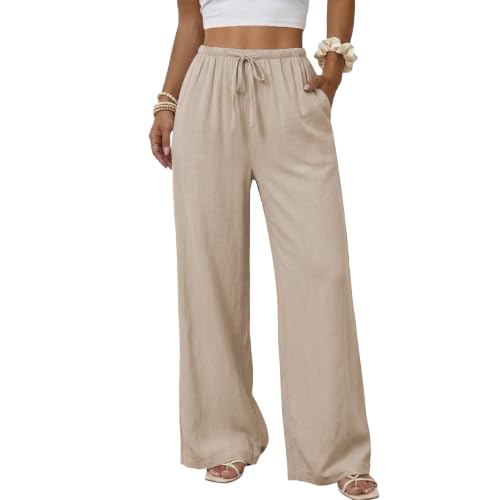
You do not need to purchase reference pants to choose a pattern. Listing photographs can still help you name what you want. The Duyang cotton-linen palazzo listing names a drawstring elastic waist and pockets, useful features to put on a project checklist. Its title does not reveal a sewing pattern or establish fabric percentages.
The Arolina stretchy lounge palazzo listing provides a different reference category. Its advertised stretch makes it a reminder to check whether your selected pattern needs knit behavior or woven structure. Neither ready-made example should be treated as a tracing template or as proof that an unrelated pattern will fit you. They are visual prompts for choosing construction features.
Make the purchase decision with a short audit
Before buying, confirm that you can answer three questions: does the size range cover the relevant measurements, does the pattern support your intended fabric, and can you obtain the required notions? Add a fourth when you have a deadline: is there time for a sample and one revision? If the answer is uncertain, resolve that uncertainty before buying several yards of final fabric.
Save the technical drawing and your five project requirements beside the pattern file. When inspiration leads you toward a different waistband or dramatic new silhouette, return to that note. You may decide to change the project, but it will be a deliberate choice. A well-chosen pattern is one whose starting assumptions are close enough to your goal that fitting remains understandable.
Frequently asked questions
Should I choose a free pattern for my first pair?
A free pattern can be useful if it includes reliable scaling, a suitable size chart, complete pieces and clear instructions. Price alone does not establish quality. Check the actual documentation and whether the designer provides corrections or support before committing your final fabric.
Can I simply make a cropped pattern longer?
Sometimes, but first check the designer's supported views and lengthening guidance. Added length can change the fabric layout and the way the leg hangs. A pattern that already includes a full-length view gives you a clearer starting point than an unsupported modification.
Is an elastic waistband always easier?
It can remove the need for a zipper, but it still involves choosing elastic, constructing a casing and ensuring the garment can pass over the hips. A complicated gathered or partially elastic waist may require more attention than its casual appearance suggests.
Do I need to sew pockets into the fitting sample?
Include them when their placement, opening or bulk is part of your uncertainty. If you are checking only broad rise and waist relationships, you may simplify the sample initially. Keep enough of the construction to reproduce the fit problem you need to understand.
Final Verdict
Choose the pattern whose drawing, measurements and instructions come closest to the pants you actually want to wear. A dramatic photograph is useful inspiration, but a compatible fabric recommendation and understandable waistband will do more for the finished project. Check the size range, confirm the selected view and make a scale-checked fitting sample before cutting special fabric. Keep your first version focused: a small number of deliberate changes is easier to evaluate than a complete redesign. Ready-made pants can help you describe features, while the pattern publisher's instructions remain the authority for constructing that particular design.