Best Overall
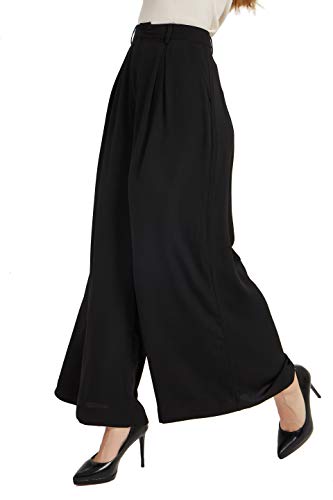
Tronjori High-waist business palazzo pants
A black dress-oriented palazzo example to compare with smooth ankle boots.
Exact hem and shaft clearance need checking.
View on AmazonStyle
A boot can disappear beneath palazzo pants and still determine whether the outfit works. Its shaft may interrupt the drape, its pull tab may catch the hem, or its sole may hold loose fabric behind your heel. Those are useful things to discover at home, before you spend a day pulling a trouser leg back into place.
Begin with the boots you trust for the day's conditions. Then assess the space around them. A flowing trouser leg should pass over the footwear, move when you move and fall back without assistance. From there, you can decide how much boot you want the outfit to show.
As an Amazon Associate I earn from qualifying purchases. Purchases take place on Amazon.
Best Overall
A black dress-oriented palazzo example to compare with smooth ankle boots.
Exact hem and shaft clearance need checking.
View on AmazonBest Budget

Casual black flowing pants for an affordable boot-pairing experiment.
No warmth or weather-protection claim is established.
View on AmazonBest Premium

Higher-priced solid-black flowing pants for a quiet tonal boot outfit.
The title does not establish lining or winter suitability.
View on AmazonThese are editorial shopping starting points based on listed details, not hands-on tests. Budget and Premium describe relative asking-price tiers among the featured options when researched; they do not establish product quality. Confirm the selected size, composition and current price on Amazon. How we choose examples.

Boot shaft height is the distance the boot extends up the leg. Shaft width describes the space around the ankle or calf. Heel or sole height changes how high the trousers sit above the ground. A boot can be short but wide, tall but close-fitting, or flat with a substantial sole. Looking only at a product photograph can hide all three differences.
For outfit purposes, the relationship matters more than any isolated number. A wide palazzo hem may easily cover a substantial ankle boot, while a narrower section higher on the trouser leg catches against a tall shaft. Similarly, a tall boot that disappears when you stand may show an outline when you sit. Try the complete overlap rather than choosing boots solely because their opening looks small.
With full-length trousers, you may see mainly the toe and a little sole. This lets the pants remain the visual focus. A dark boot under dark fabric creates a quiet continuation, while a contrasting toe adds a deliberate accent. Neither option requires the toe to be pointed, and there is no reason to buy decorative ankle hardware if the pants will cover it.
A shorter wide leg can show more of the shaft. That is a different proportion, and it can work well when the exposed boot is intended as part of the outfit. Leave enough overlap that the hem does not repeatedly catch on the shaft edge. If there is a gap, judge whether you like it and whether it provides the coverage you need; a visible ankle is not a styling error by itself.
| What you notice | Likely area to inspect | Useful adjustment |
|---|---|---|
| Fabric remains raised after sitting | Shaft edge and trouser width | Try a smoother or narrower shaft |
| A small point catches repeatedly | Zip pull, buckle or rear tab | Choose less protruding hardware |
| Hem folds beneath the heel | Trouser length and rear sole | Change length or footwear pairing |
| Calf outline shows through the pants | Tall shaft beneath narrower fabric | Try ankle boots or a roomier leg |
| Leg sticks to socks or layers | Surfaces touching inside the pants | Try a smoother compatible layer |
| Cold gap appears when seated | Overlap above the boot | Adjust sock coverage or boot height |
These are practical observations rather than diagnoses of a manufacturing fault. Two well-made pieces can simply be incompatible. Change one element at a time so you can tell whether the problem came from length, hardware, the shaft or the layer beneath it.
An ankle boot places less material inside the upper trouser leg than a tall boot. Start with a pair whose opening sits comfortably around your ankle and whose zip or pull tabs do not project sharply. Pull the trousers over the boot while standing, then take a few ordinary steps. Do not keep smoothing the fabric during the check; you need to see how it behaves on its own.
For a simple daytime outfit, try black palazzo pants, a compact knit and ankle boots. If the pants are fluid and the knit is soft, a bag with a defined shape can add a clearer edge. For a more relaxed version, use a roomy overshirt and let the boots remain mostly hidden. These are styling choices, not rules about which body proportions can wear volume.
Tall boots can provide coverage when the trouser hem lifts while you sit, but more coverage also means more material beneath the pants. Check the area around the calf and the top of the shaft. A straight or rigid shaft can show through some fabrics; a roomy trouser leg may conceal it comfortably. Neither result can be guaranteed from the term palazzo alone.
Try sitting with your knees bent, standing without touching the hem and taking a careful step upward. Look for fabric resting on the shaft rather than dropping over it. If a tall boot only works while you stand perfectly still, an ankle boot plus an appropriate sock may be a simpler arrangement. Do not fold a broad trouser leg into a tight shaft merely to make the pieces fit together.
The usual starting point is to wear palazzo pants over boots. Tucking a large amount of fabric inside introduces folds around the ankle and calf, and it replaces the open-leg silhouette with a gathered one. You can intentionally create another look, but it should be comfortable and secure, not a forced workaround for a dragging hem.
If a commute involves mud, deep puddles or conditions that require close-fitting trouser legs, consider changing trousers for that part of the day. Palazzo styling cannot make every hem suitable for every route. Carrying a clean indoor pair or selecting another outfit may be more useful than attempting to wrap, pin or stuff loose fabric into footwear that was not designed to hold it.
A chunky sole and a fine-soled ankle boot can produce different ground clearance even when both are described as flat. Put on the boots before deciding where the pants should finish. Check the rear hem as well as the front: the front may rest on the toe while the back hangs lower. Keep the waistband in its normal wearing position during the assessment.
Do not assume a heel automatically solves excess length. The front of the shoe may still be low, and fabric may catch around the heel during a stride. For the fitting decision itself, follow the finished-length guide. If you rotate between two boots, establish whether both work with the existing hem before making either part of a regular outfit.
Choose socks according to the boots, the temperature and your own comfort preferences. Then repeat the movement check with those socks on. A bulky sock can change how the shaft closes or where its top sits. A layer that looks unobtrusive on its own can also add enough volume to alter the way the trouser leg falls over the calf.
When adding a base layer beneath the pants, look for bunching where it meets the sock or boot top. Smooth that junction before judging the outfit. Avoid piling several folded edges into the same narrow area. The broader question of building a warm outfit belongs in the winter palazzo guide; the boot-specific task is making each overlapping piece sit comfortably and move freely.
Boots vary in weather protection. Use the maker's instructions and specifications for the exact pair rather than treating leather, a thick sole or an ankle-high shape as proof of waterproofing. The pants also need to stay clear of the wet surface. A boot may keep the foot covered while the trouser hem still brushes puddles.
After exposure to rain or dirt, follow each garment's care instructions separately. GINETEX explains that care labeling concerns the complete textile article, including aspects beyond the main fiber. That is a reason to check the actual trouser label before applying heat or cleaning a marked hem. It is not a boot-care instruction; footwear needs its own guidance.
For a dark casual outfit, Ulovmi black high-waisted flowing palazzo pants with pockets are a title-supported example to examine beside ankle boots. Confirm leg dimensions and length before judging whether your shaft will fit. The listing's lounge description suggests a relaxed styling direction, not a promise of cold-weather performance.
If you want a dress-oriented starting point, consider the title of Tronjori black high-waist palazzo business pants. Compare them with a smooth boot and a structured jacket. Their name does not verify warmth, lining or compatibility with a particular heel. Both examples are useful for building an outfit question; neither substitutes for trying the boots under the selected trousers.
Many boot problems appear at a desk, in a car or on public transport. Sit for a moment, cross and uncross your ankles if comfortable, then stand naturally. Does either trouser leg stay hooked above the boot? Does the shaft edge press awkwardly through the pants? Does the hem drop back without your hand? These observations are more useful than a single mirror pose.
Once the movement works, add the coat you will actually wear. A long coat and broad pants can create an intentionally generous silhouette; a shorter jacket leaves more of the trouser line visible. Keep the boot choice grounded in coverage and clearance while the upper layers establish the outfit's mood.
Yes, if the hem is compatible with the actual sole height and the shaft releases the fabric. Flat does not mean thin-soled, so compare your own boots. If trousers already fit a high heel, they may need a different length before they work with a lower boot.
It can. Decide whether you want a visible shaft, a small gap or continuous coverage. Then walk and sit to check that the hem does not lodge on the top edge. Cropped wide-leg pants are an adjacent silhouette, so do not expect them to behave like floor-length palazzo trousers.
Inspect that boot's zip pull, tab and shaft edge, and compare the two hems. Small differences in how you move or how fabric is arranged can expose a catch on only one side. Test a smoother boot before assuming the trousers need a major alteration.
A successful palazzo-and-boots outfit depends on a clean overlap. The trouser leg needs room around the shaft, enough ground clearance and a clear path back into place after you sit. Ankle boots are a sensible starting point because they place less material beneath the pants; taller styles remain an option when their extra coverage serves your day. Use the exact socks, layers and sole you intend to wear during your fitting check. Once that practical arrangement works, tonal colors, contrasting toes and different jacket lengths are matters of preference. Keep the outfit that moves naturally through your real routine.